
Introduction
The Nobel Prize is the world’s top honor for outstanding achievements in science, literature, peace, medicine, and economics. Created over a hundred years ago, it celebrates people and groups whose work has helped humanity. Indian Nobel Prize winners have made the country proud with their talent and kindness.
Origin and Background of the Nobel Prize
Alfred Nobel, a Swedish chemist and inventor best known for creating dynamite, started the Nobel Prize. Concerned about how he would be remembered, he donated his fortune to create a fund that rewards the person who makes the most significant contribution to humanity each year.
Alfred Nobel’s money funds the prizes, but four organizations he chose are responsible for awarding them, ensuring the process remains fair and expert-driven.
| Physics | The Royal Swedish Academy of Sciences | Sweden |
| Chemistry | The Royal Swedish Academy of Sciences | Sweden |
| Physiology or Medicine | The Nobel Assembly at the Karolinska Institute | Sweden |
| Literature | The Swedish Academy | Sweden |
| Peace | The Norwegian Nobel Committee (appointed by the Norwegian Parliament) | Norway |
| Economic Sciences (added in 1969) | The Royal Swedish Academy of Sciences | Sweden |
Note: Although there are six Nobel Prize categories, only four institutions award them. The Royal Swedish Academy of Sciences administers three of these fields: Physics, Chemistry, and Economics.
Why Sweden and Norway Both Award Nobel Prizes
When Nobel wrote his will in 1895, Sweden and Norway shared a king, even though they were separate countries. He awarded most of the prizes to Swedish groups, but chose a Norwegian committee for the Peace Prize because Norway was known for its commitment to democracy and peace.
After the union was dissolved in 1905, this arrangement persisted, making the Nobel system uniquely shared between the two countries to this day.
Selection Procedure
The Nobel selection process is known for its independence and confidentiality:
- Nominations: Only invited individuals, such as Nobel laureates, professors, and experts, can nominate candidates.
- Evaluation: Nobel Committees review and verify contributions.
- Recommendations: Shortlisted names are forwarded to the awarding institutions.
- Decision: Final voting and selection take place within each institution.
All nomination details are kept secret for 50 years to ensure the process remains fair and unbiased.
Prize Amount and Ceremony
Each laureate receives:
- A gold medal,
- A diploma, and
- A cash prize, which is usually about 11 million Swedish kronor, or roughly 1 million US dollars, though the amount can change each year.
The prizes are announced in October, and the official award ceremonies take place on December 10, the anniversary of Alfred Nobel’s death.
The Peace Prize ceremony is held in Oslo, Norway, while all others are presented in Stockholm, Sweden.
Streams in Which Nobel Prizes Are Awarded
Today, Nobel Prizes are conferred in six major fields:
- Physics
- Chemistry
- Physiology or Medicine
- Literature
- Peace
- Economic Sciences (in Memory of Alfred Nobel)
Indian Nobel Prize Winners
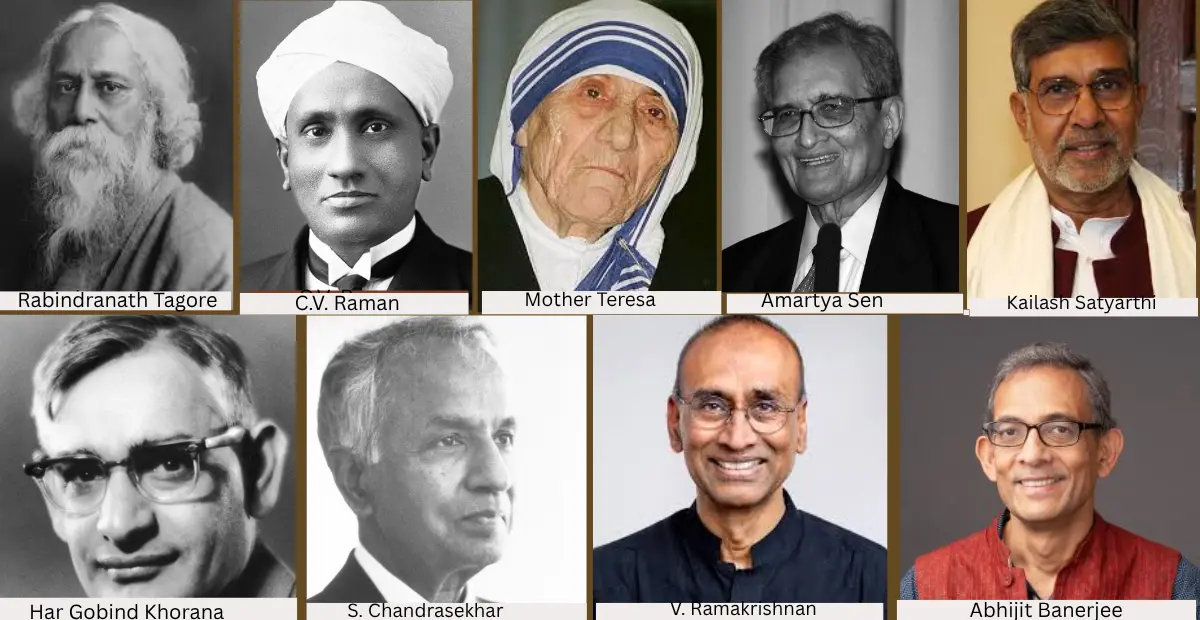
India has produced several Nobel laureates whose work has advanced global knowledge, literature, and humanitarian causes.
| Rabindranath Tagore | 1913 | Literature | First Asian Nobel laureate; honored for his poetic masterpiece, Gitanjali, which reflects deep spiritual and cultural insight. |
| C. V. Raman | 1930 | Physics | Discovered the Raman Effect, explaining the scattering of light — a landmark in spectroscopy. |
| Har Gobind Khorana | 1968 | Medicine | Deciphered the genetic code and its role in protein synthesis (shared with Robert Holley and Marshall Nirenberg). |
| Mother Teresa | 1979 | Peace | Recognized for her humanitarian service to the poor through the Missionaries of Charity in Kolkata. |
| Subrahmanyan Chandrasekhar | 1983 | Physics | Awarded for his theoretical work on stellar evolution and the Chandrasekhar limit. |
| Amartya Sen | 1998 | Economics | Honored for his work in welfare economics and social justice, especially on poverty and human development. |
| Venkatraman Ramakrishnan | 2009 | Chemistry | Recognized for studies on the structure and function of the ribosome — vital to understanding protein synthesis. |
| Kailash Satyarthi | 2014 | Peace | Awarded for his tireless campaign against child labor and advocacy for children’s right to education. |
| Abhijit Banerjee | 2019 | Economics | Shared Nobel Prize with Esther Duflo and Michael Kremer for an experimental approach to alleviating global poverty |
India’s Nobel Legacy
India is very proud of its Nobel Laureates, whose achievements show the country’s intelligence and caring spirit. Indian winners like Rabindranath Tagore, C.V. Raman, Mother Teresa, Amartya Sen, and Kailash Satyarthi received the prize as Indian citizens for their work in literature, physics, peace, and economics.
There are also Nobel Laureates of Indian origin, such as Har Gobind Khorana, Subrahmanyan Chandrasekhar, Venkatraman Ramakrishnan, and Abhijit Banerjee, who have brought international recognition to Indian scholarship. Even though they were citizens of the US or UK when they won, their early years and education in India remain a source of national pride.
All Indian Nobel Prize winners represent a part of the country’s intellectual, cultural, and moral spirit, from Tagore’s poetry and Raman’s science to Satyarthi’s work for justice. Their achievements inspire new generations to aim for excellence and kindness.
Conclusion
The Nobel Prize stands for excellence, compassion, and progress. Alfred Nobel’s unique system, run by Sweden and Norway and managed by four independent institutions, still honors people who make the world better through knowledge and peace.
Indian Nobel Prize winners have brought pride to the country and embodied the core ideals of the Nobel legacy: serving humanity through wisdom and action.
FAQs on Nobel Prize and Indian Nobel Prize Winners
Q1. Who manages the finances and administration of the Nobel Prizes?
Ans. The Nobel Foundation, founded in 1900, handles all administrative, financial, and organizational matters related to the Nobel Prizes. It ensures that prizes are awarded in accordance with Alfred Nobel’s will and manages the investment of his endowment to support the annual awards.
Q2. Can a Nobel Prize be revoked or withdrawn once awarded?
Ans. No. The Nobel Prize cannot be revoked once it has been officially announced and awarded. This rule applies even if controversies or disputes arise later regarding the laureate’s work or conduct.
Q3. Can Nobel Prizes be awarded posthumously?
Ans. Generally, no. According to Nobel Foundation rules (since 1974), a prize cannot be awarded posthumously unless the laureate dies after being officially announced as a winner but before the award ceremony.
Q4. How are Nobel laureates notified that they have won?
Ans. Laureates are usually notified by phone shortly before the public announcement. In several cases, winners have been famously surprised by early-morning calls from Sweden or Norway informing them of their award.
Q5. How many people can share a Nobel Prize in one category?
Ans. Up to three people can share a Nobel Prize in any category. If a prize is shared, the total cash amount is divided among them — either equally or in proportions chosen by the awarding committee.
Q6. What is the Nobel medal made of?
Ans. The Nobel medals for Physics, Chemistry, Medicine, and Literature are made of 18-carat recycled gold, plated with 24-carat pure gold. The Peace Prize medal, awarded in Norway, has a slightly different design but similar composition.
Q7. Is there a Nobel Prize in Mathematics?
Ans. No. There is no Nobel Prize in Mathematics. Various theories exist about why Alfred Nobel excluded it, but none are confirmed. To recognize excellence in mathematics, the Fields Medal (awarded every four years) and the Abel Prize (awarded annually) are considered equivalent honors.
Q8. What is the difference between the Nobel Prize and the Nobel Memorial Prize in Economic Sciences?
Ans. The Nobel Memorial Prize in Economic Sciences was not part of Alfred Nobel’s original will. It was established later in 1969 by the Sveriges Riksbank (Swedish Central Bank) in Nobel’s memory.
It is, however, administered and awarded in the same manner as the original Nobel Prizes and is equally prestigious.
Q9. Who was the first Asian Nobel Prize winner?
Ans. Rabindranath Tagore from India was the first Asian and Indian Nobel Prize Winner, receiving the Nobel Prize in Literature in 1913 for his poetic collection Gitanjali.
Q10. Has any Indian organization received a Nobel Prize?
Ans. While no purely Indian institution has received a Nobel Prize, the International Campaign to Ban Landmines (ICBL) — co-founded by Indian activist Jody Williams — received the 1997 Peace Prize. Indian citizens, however, like Mother Teresa and Kailash Satyarthi, have received the Peace Prize for their humanitarian work through organizations based in India.
Q.11. Why is the Nobel Peace Prize awarded in Norway and not Sweden?
Ans. Alfred Nobel chose Norway for the Peace Prize because, during his lifetime, Norway had a strong democratic tradition and a reputation for peaceful diplomacy. Even after the dissolution of the Sweden–Norway union in 1905, this arrangement continued according to Nobel’s will.
Q12. What do Nobel Prize laureates deliver during the award ceremony?
Ans. Each laureate delivers a Nobel Lecture about their work’s importance, research, or contribution to peace or literature. These lectures are published in the official Nobel archives and serve as valuable references in their respective fields.
Q13. How many Nobel laureates are of Indian origin but not Indian citizens?
Ans. Several laureates were born in India but held foreign citizenship at the time of their award — including Har Gobind Khorana (USA), Subrahmanyan Chandrasekhar (USA), Abhijit Banerjee (USA), and Venkatraman Ramakrishnan (UK/USA).
Q14. Where are the Nobel Prizes presented each year?
Ans. The Peace Prize is awarded in Oslo, Norway, by the Norwegian Nobel Committee. However, all other prizes — Physics, Chemistry, Medicine, Literature, and Economics — are presented in Stockholm, Sweden, during a grand ceremony on December 10, the anniversary of Alfred Nobel’s death.
Q15. How are Nobel laureates selected from nominations?
Ans. Nominations are sought from qualified experts worldwide. The Nobel Committees in each field thoroughly review and research the contributions. The final decision is made through voting by members of the respective awarding institution. The nomination process and deliberations remain confidential for 50 years.