
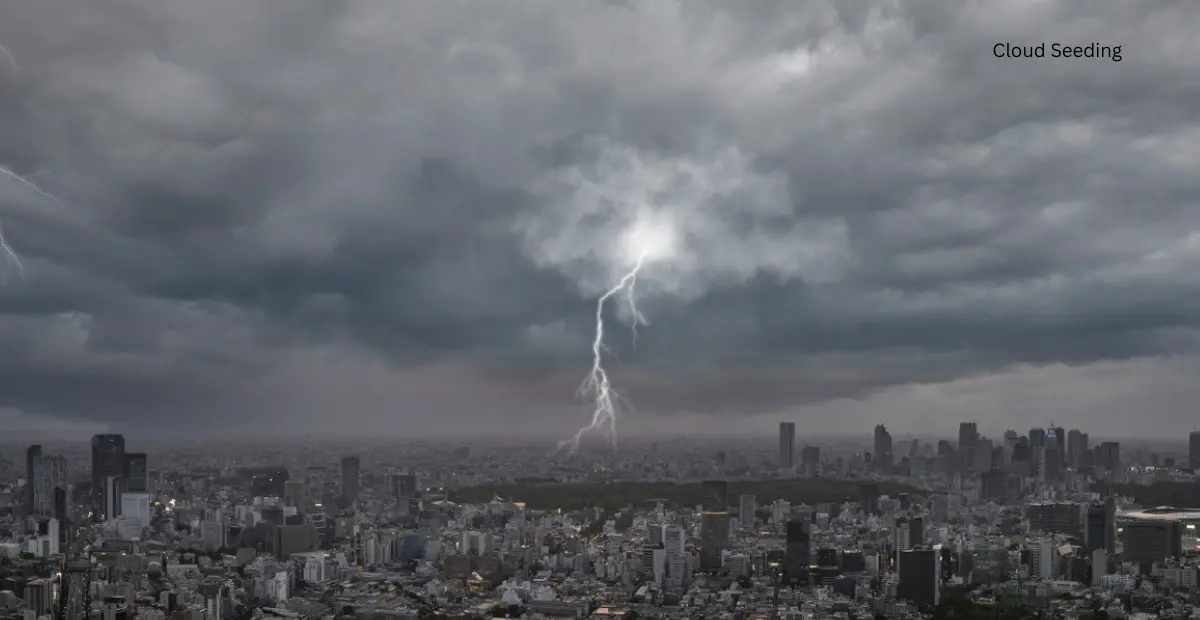
Introduction: Delhi’s Search for Artificial Rain
Every winter, Delhi’s air becomes toxic, and people hope for one thing: rain. But what if we could make it rain intentionally? This is where Cloud Seeding in Delhi comes in.
In 2025, Delhi authorities announced plans to experiment with artificial rainfall to fight severe smog. The technique, known as cloud seeding, is not new. It has been used worldwide for over 75 years to produce rain, manage droughts, and reduce pollution.
Let’s explore how this science works, who invented it, what chemicals are used, its costs, and whether it’s truly a long-term solution for Delhi’s skies.
What Is Cloud Seeding? The Science Behind Making Rain
Cloud seeding is a weather modification process aimed at increasing natural rainfall. Scientists add special particles to clouds to promote the formation of rain droplets or ice crystals, depending on the temperature and moisture conditions.
In simple terms:
The cloud seeding gives clouds the “push” they need to start raining.
There are two primary methods:
- Glaciogenic seeding—used for cold clouds; involves injecting silver iodide or dry ice to form ice crystals that turn into raindrops.
- Hygroscopic Seeding—used Identify appropriate clouds: Meteorologists look for moisture-rich clouds at the correct temperature and altitude.
Step-by-Step: How Cloud Seeding Works
- Identify appropriate clouds: Meteorologists look for moisture-rich clouds at the correct temperature and altitude.
- Select Seeding Method: Depending on the cloud type, they choose between glaciogenic (cold-cloud) or hygroscopic (warm-cloud) seeding.
- Deploy Aircraft or Rockets: Specialized aircraft equipped with flare dispensers release seeding agents at designated altitudes.
- Formation of Raindrops: Chemicals serve as “nuclei” that attract moisture, resulting in the formation of larger droplets or ice crystals.
- Rainfall or snowfall occurs when the droplets become heavy enough, and gravity pulls them down, causing it to rain or snow.
- Monitor & Measure: Ground stations and satellites observe shifts in rainfall and air quality.
Cloud Seeding Experiments in India: From Drought Relief to Smog Control
India has been testing cloud seeding since the 1950s, when IITM Pune conducted early experiments with silver iodide and dry ice. States like Tamil Nadu, Karnataka, Maharashtra, and Andhra Pradesh later used it to combat droughts, while Delhi is now exploring it to reduce pollution. Although results have been mixed, these trials have provided valuable data on how India’s monsoon clouds respond to artificial seeding.
The Global Journey: How the World Uses Cloud Seeding
Cloud seeding is not only an Indian experiment. Many countries use it to boost rainfall, increase snowfall, or help control air pollution.
| USA | Snowpack enhancement | Began in the 1940s and was used in Western states for water management. |
| China | Weather modification | World’s most extensive program for drought relief and extreme weather control. |
| UAE | Rain enhancement | Over 500 cloud-seeding missions yearly for water security. |
| Australia | Drought and bushfire prevention | Research-led seeding for rainfall augmentation. |
| Thailand & Indonesia | Pollution control | Occasional operations to reduce haze and smog. |
The Origin Story: Who Invented Cloud Seeding
The first successful cloud seeding experiment took place in 1946 in the United States.
- Inventor: Dr. Vincent J. Schaefer
- Institution: General Electric Research Laboratory, New York
- Method: Used dry ice (solid CO₂) dropped into a supercooled cloud to create artificial snow.
- Result: The world’s first man-made precipitation.
Later that same year, Dr. Bernard Vonnegut (also at GE) discovered silver iodide, which became the basis for modern cloud seeding because of its ice-like crystalline structure.
Since then, dozens of countries have tested and refined this process to achieve different climate goals.
What Chemicals Are Used in Cloud Seeding
The effectiveness of the cloud seeding process depends heavily on the type and purity of chemicals used:
| Glaciogenic agents | Silver iodide (AgI), Potassium iodide (KI), Dry ice (CO₂) | Encourage ice formation in cold clouds. |
| Hygroscopic agents | Sodium chloride (NaCl), Calcium chloride (CaCl₂) | Help water droplets grow and merge in warm clouds. |
| New-age alternatives | Liquid propane, salt flares | Used in eco-friendly and low-toxicity seeding experiments. |
The amounts used are small—just a few kilograms spread over large cloud regions. Most studies indicate minimal environmental or health risks, but monitoring remains crucial, especially for silver-based chemicals.
Economic Feasibility: Is Cloud Seeding Too Expensive
While the science is fascinating, the expense of cloud seeding remains significant, particularly with repeated applications.
Estimated Costs
- Small pilot project (like Delhi’s plan): ₹10–12 crore for 2–3 days.
- Large programs (China, UAE): ₹10–50 crore (USD 1–6 million) per year.
Why It’s Costly
- Aircraft rental and maintenance
- Specialized flare and seeding equipment
- Chemical materials (silver iodide is expensive)
- Fuel and flight hours
- Continuous monitoring and data analysis
- Weather constraints — aircraft may remain. Weather constraints can cause aircraft to wait on standby for days in Delhi, which would be economically impractical because:
- Suitable cloud conditions occur for only a few weeks annually.
- Rain temporarily clears pollution — not permanently. Rain only reduces pollution for a short period, not forever. Instead, focus on reducing emissions, increasing green cover, or building clean energy infrastructure.
Thus, experts recommend using it as a seasonal or emergency measure, not as routine pollution control.
The Good and Bad Effects of Cloud Seeding Over Time
| Immediate (hours–days) | Rainfall cleans the air by washing out PM2.5/PM10; improves visibility; provides temporary relief from smog. | Uneven rainfall may cause traffic issues or localized flooding. |
| Short Term (days–weeks) | Noticeable air-quality improvement; health relief for respiratory patients. | Possible chemical residues in runoff; uncertain consistency of results. |
| Medium Term (months) | Valuable scientific data for future planning. | Accumulated silver residues (though low) may need monitoring. |
| Long Term (years) | Potential water security benefits in dry regions. | High recurring costs; difficulty in proving long-term efficiency; ethical debates about “weather ownership.” |
Safety and Environmental Concerns
Studies worldwide suggest that silver iodide and salt particles, in the trace amounts used, have negligible ecological impact.
However, responsible programs always include:
- Soil and water quality monitoring
- Independent toxicity assessments
- Public transparency in data
Delhi’s pilot also plans post-seeding air and water testing to ensure safety compliance.
Why Cloud Seeding in Delhi Can’t Be a Permanent Fix
- It cannot create clouds; it only works when clouds are already in the sky.
- Rainfall from seeding lasts only a few hours to a day.
- Pollution returns quickly if the sources of emissions remain unchecked.
Experts stress that cloud seeding should support, not substitute for, policies aimed at vehicular, industrial, and agricultural emissions.
Final Thoughts: A Silver Lining, But Not a Silver Bullet
Cloud seeding in Delhi is an innovative and daring experiment. It is a technological method to improve air quality and cool the city temporarily. However, it’s not a long-term solution. It provides short-term relief, useful in emergencies or for research, but it cannot replace strong air-quality policies.
The proper solution for Delhi will combine policy, science, and public action, along with the occasional well-timed seeded cloud.
Frequently Asked Questions (FAQs) on Cloud Seeding in Delhi
Q1. Can cloud seeding in Delhi cause floods or excessive rainfall?
No. Cloud seeding can only slightly increase rainfall if suitable clouds are already present. It cannot generate or intensify storms to the point of causing widespread flooding. The process affects the weather locally and temporarily.
Q2. Does cloud seeding in Delhi influence rainfall in nearby regions?
There is no solid scientific evidence to support that cloud seeding in Delhi will reduce rainfall in neighboring areas. However, scientists continue to research potential micro-level changes in rainfall patterns caused by artificial cloud modification.
Q3. Who regulates cloud seeding operations in India?
India currently lacks a specific national law for weather modification. The India Meteorological Department (IMD), IITs, and state governments typically oversee projects, ensuring adherence to environmental and air safety standards.
Q4. Can cloud seeding in Delhi help fight climate change?
No. Cloud seeding is a short-term weather management technique — it cannot reverse or mitigate global climate change. Its effect is limited to local atmospheric conditions and brief periods.
Q5. What technologies are used in modern cloud seeding?
Modern cloud seeding relies on radar-guided aircraft, flares, and increasingly, drones for precision targeting. Meteorological modeling and satellite data help determine the best time and place to release seeding agents.
Q6. Can drones replace aircraft in cloud seeding?
Partially. Drones are being tested in countries like the UAE and China for low-altitude seeding. They are cheaper and safer but are currently limited in capacity and altitude compared to traditional aircraft.
Q7. Are there environmental risks from the chemicals used in cloud seeding in Delhi?
Studies show that the amounts of chemicals, such as silver iodide, used are too small to significantly harm soil, water, or air quality. However, long-term environmental monitoring is still recommended during recurring operations.