
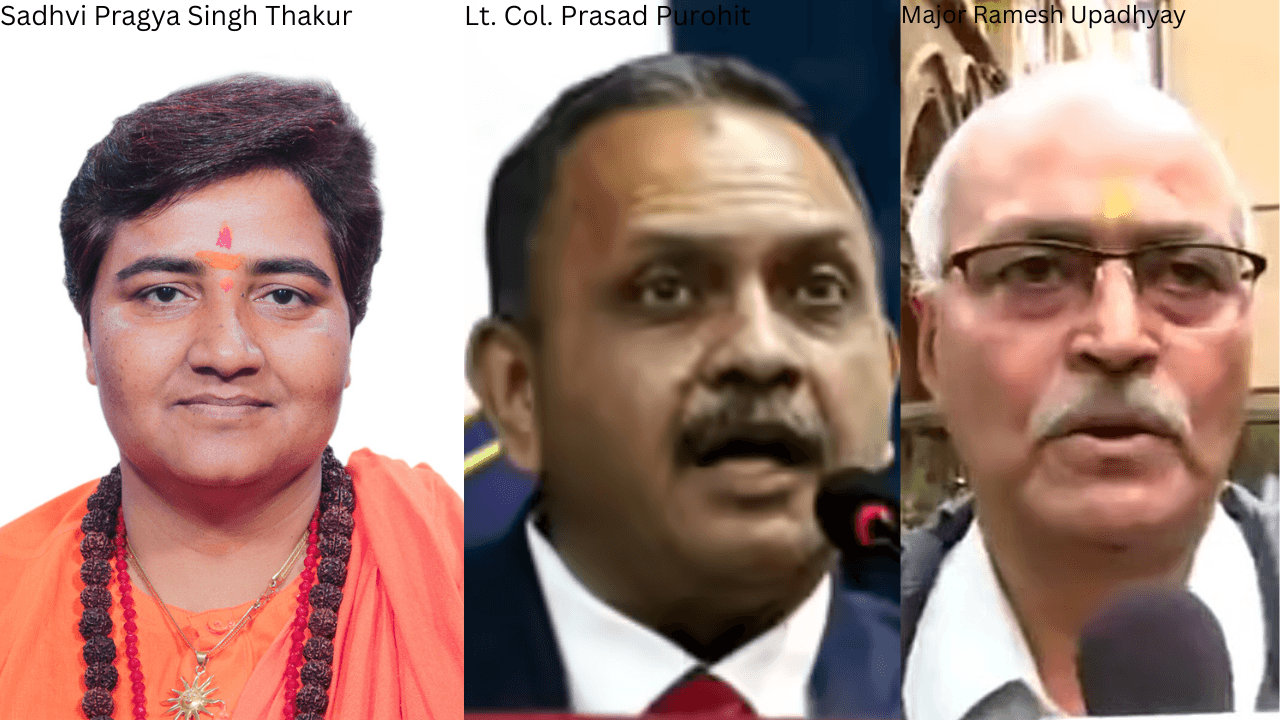
The Special NIA Court, Mumbai, acquitted all seven accused in the 17-year-old Malegaon Bomb Blast case on July 31, 2025. In a court packed with all the accused, journalists, relatives of the victims, and their legal representatives, Special Judge A.K. Lahoti pronounced the judgment. Before getting bail on different dates, Sadhvi Pragya Thakur, Lt. Col. Prasad Purohit, Major (Retd.) Ramesh Upadhyay and others had spent some years in jail.
Outside the courtroom, there was an atmosphere mixed of joy and sorrow. After many years of trials, the accused finally got relief, on the other hand, the victims’ families had expressed frustration and disbelief over the outcome.
What Happened in Malegaon Bomb Blast case
On the night of September 29, 2008, explosive devices strapped to an LML Freedom motorcycle exploded in a crowded area of Bhikku Chowk in Malegaon. 6 people were killed, and more than 100 people were injured in the incident. Though the court found the number of injured to be 95. At that time, the Mumbai Bomb blast was seen as a terrorist attack. However, during the investigation, investigators said that some Hindu extremist groups were involved in it. The ruling parties named the act “Saffron terror” or “Hindu terror” aimed at terrorizing the Islamist groups.
This case was initially investigated by the Local Police, but transferred to Maharashtra ATS under the leadership of Late Hemant Karkare. Later, the Malegaon Bomb blast case was handed over to the National Investigation Agency (NIA). The names of the seven accused in this case are as follows:
- Sadhvi Pragya Singh Thakur
- Lt. Col. Prasad Purohit
- Major (Retd.) Ramesh Upadhyay
- Sameer Kulkarni
- Ajay Rahirkar
- Sudhakar Chaturvedi
- Sudhakar Dwivedi
A case was filed against all seven accused under the “Unlawful Activities Prevention Act (UAPA)”, “Indian Penal Code”, “Explosives Act”, and “Arms Act”. Special Court dropped the charges framed under the Maharashtra Control of Organized Crime Act (MCOCA) against the accused, due to lack of evidence. The prosecution alleged that this was an act of a so-called Hindu extremist group working against Islamist groups. The trial of this case proceeded at a very slow pace and took a lot of time. In the meantime, many witnesses turned hostile.
The Verdict: All Acquitted
In its final judgement running more than 400 pages, the court observed that there was a complete absence of concrete evidence linking the accused to the terrorist act. During the trial, more than 320 prosecution witnesses were examined, of whom 37 witnesses turned hostile, including the witness who had earlier accepted the theory of the prosecution.
In the order, the Judge observed that no one can be proven guilty just based on suspicion. In the absence of strong legal evidence, all culprits were given the benefit of the doubt. All seven accused, including Pragya Thakur and Col. Purohit, were acquitted of all charges. As per DD News report, the court ordered the Government to pay compensation of ₹2 lakh to the families of each deceased person and ₹50,000 to each injured person.
Emotions Run High – From the Courtroom to the Streets
The atmosphere outside the courtroom was mixed. While on one hand, the families of the victims were quite disappointed that no one was found guilty in the judgment, on the other hand, the accused breathed a sigh of relief after so many years spent in trial. They expressed their faith in the Indian Justice system and said that the court has confirmed their innocence.
While meeting the press people, Col. Purohit expressed his gratitude to the judiciary for doing justice. He also thanked his organization, the Indian Army, his lawyers, and the countrymen for supporting him. Sameer Kulkarni accused Congress leaders of framing him and other accused on false grounds in Malegaon Bomb Blast case. Retd. Major Ramesh Upadhyay also said that they were framed in a false case, and he is confident that he, along with other accused, will win the case in every court of law.
Sadhvi Pragya Thakur also welcomed the verdict and expressed happiness at being acquitted by the court. She said she was tortured and falsely made an accused in the Malegaon Bomb Blast case by the Maharashtra ATS. She said that “truth always wins. This is the victory of religion”.
Political Reactions – Predictably Divided
A political storm erupted after the Court verdict in the Malegaon Bomb blast case. Congress called it a dark day and alleged that institutions were compromised. Opposition parties, especially Congress, accused the government of manipulating the report of the investigating agencies.
In response to this, the BJP blamed the then-ruling party, which initially motivated the case politically and trapped innocent individuals in a false case for ideological reasons. BJP leaders called the whole episode a part of Congress conspiracy to malign the Hindu Sanatan Dharma. They said that all the accused were found ‘not guilty’.
What This Verdict Means for India
The Malegaon Bomb blast case is more than just a criminal case. It has raised questions on the fairness of investigating agencies, challenged the narrative on terrorism, and tried to touch the delicate fabric of religious identity, nationalism, and institutional accountability.
Legal Experts say that this verdict has exposed the flaws in the Indian justice delivery system. When witnesses turn hostile, investigators change, or when there is political pressure, there is doubt about getting proper justice.
Where Do We Go From Here
After the court verdict in the Malegaon Bomb blast case, the legal chapter is over, but the societal questions still keep disturbing the thinking of our society. 17 years is a very long time. Someone was fighting to clear his name, while for someone else, the fight to get justice for their lost relatives is still on. It is open to grieving parties to appeal in higher courts against the Special NIA Court’s verdict.
In the end, the Malegaon case reminds us that in India, truth often walks a tightrope between politics and principle.