
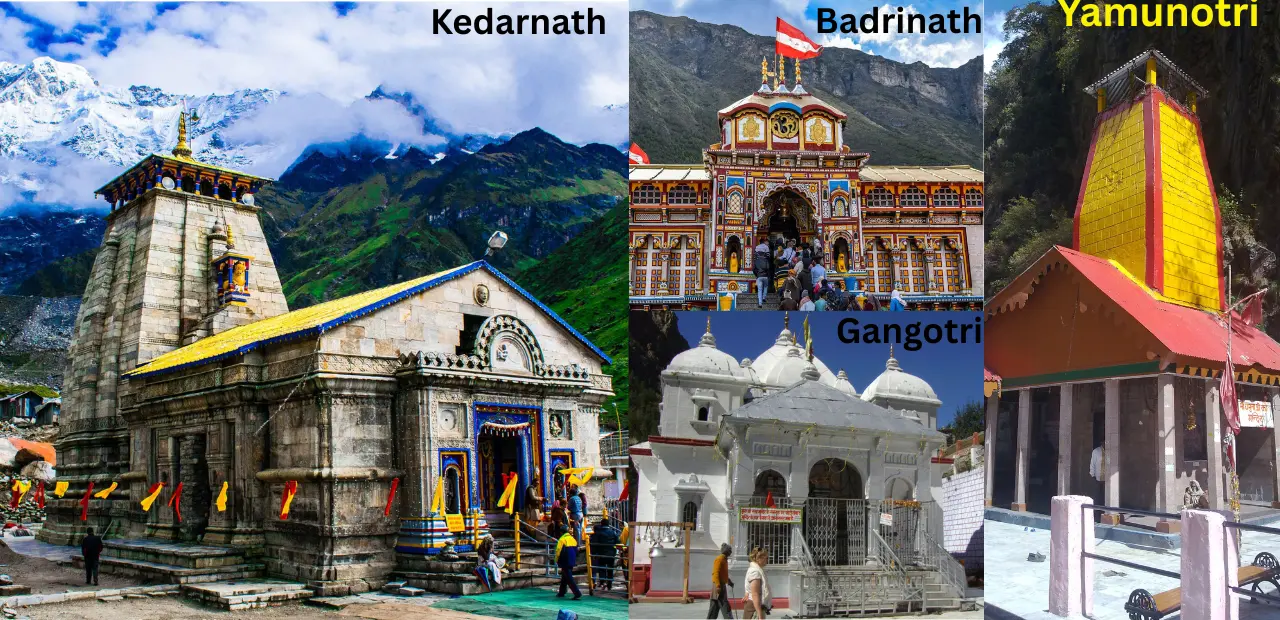
Introduction: Where Divinity Meets the Himalayas
Hidden within the misty folds of the Garhwal Himalayas is a spiritual route that has inspired saints, travelers, and poets for centuries — the Char Dham Yatra of Uttarakhand. But beyond the snow-capped peaks and pilgrim paths, there’s something even more captivating — the mythology of Char Dham temples, where every stone tells a legend and every river shares a divine story.
Embarking on this journey isn’t just about visiting four temples — it’s about following the footsteps of gods. Each of the four shrines — Yamunotri, Gangotri, Kedarnath, and Badrinath — has a unique mythological story that links heaven and earth, faith and endurance, devotion and discovery.
Yamunotri Temple: The Mythology of the River Goddess
The mythology of Char Dham temples begins at Yamunotri, the source of the sacred River Yamuna. According to Hindu belief, Goddess Yamuna is the daughter of Surya (the Sun God) and the sister of Yama, the God of Death. Pilgrims believe that bathing in the Yamuna washes away the fear of death and grants salvation.
The temple, located at an elevation of 3,291 meters, was founded by Maharaja Pratap Shah of Tehri Garhwal. Nearby, the thermal spring of Surya Kund adds a mystical atmosphere — devotees cook rice in the hot water and offer it to the goddess.
Mythological highlight: When Yama promised his sister that her devotees would not face untimely death, the Yamunotri Yatra became a journey of protection and peace.
Today, reaching Yamunotri still involves adventure — after driving to Janki Chatti, you need to trek or ride a pony or palki for about 5–6 miles to the temple. A helipad located 1 mile away at Kharsali makes access easier for the elderly and time-conscious travelers.
Gangotri Temple: The Descent of the Divine River
Continuing the story of the Char Dham temples’ mythology, Gangotri honors the origin of the holy Ganga River. Legend has it that King Bhagiratha performed intense penance there to bring the river down from heaven to purify the souls of his ancestors.
Ganga’s descent was so mighty that Lord Shiva caught her in his matted locks, softening her fall before she flowed onto Earth — a divine moment said to have occurred near Gangotri.
Mythological highlight: Gangotri represents the triumph of devotion over celestial might, where a human invites divine compassion.
Located at 3,100 meters, the white temple by the Bhagirathi River was built in the 18th century by Amar Singh Thapa, a Gorkha general. Pilgrims visiting Gangotri are reminded that every ripple in the river carries stories of liberation and life.
Helicopter services run from Dehradun and Harsil, transporting pilgrims to this sacred destination during the yatra season (May–October).
Kedarnath Temple: The Sacred Abode of Lord Shiva
Among all legends in the mythology of Char Dham temples, few are as significant as Kedarnath’s. Dedicated to Lord Shiva, this temple is believed to be one of the twelve Jyotirlingas — eternal pillars of divine light.
The story goes that after the Kurukshetra war, the Pandavas sought forgiveness for killing their kin. Lord Shiva, avoiding them, took the form of a bull and disappeared into the ground at Kedarnath — leaving behind his hump, which became the sanctum of the temple. The remaining parts appeared at other sacred sites known as the Panch Kedar.
Mythological highlight: Kedarnath is the place where divine forgiveness meets human repentance — a timeless symbol of redemption.
Standing at 3,583 meters and surrounded by snowy peaks, Kedarnath can be reached via a 16-km trek from Gaurikund or by helicopter from Phata, Sersi, or Guptakashi. The helipad near the temple makes it one of the most accessible high-altitude shrines in the Himalayas.
Parking is limited during peak season, but the Uttarakhand government has increased facilities and implemented pilgrim caps to manage crowds.
Badrinath Temple: The Abode of Lord Vishnu
The mythology surrounding the Char Dham temples reaches its peak at Badrinath, where Lord Vishnu is believed to have meditated for ages beneath a Badri (berry) tree. His consort, the Goddess Lakshmi, protected him by taking the form of the tree itself, giving the temple its name.
This temple, situated at 3,133 meters on the banks of the Alaknanda River, is regarded as one of the most sacred Vaishnavite shrines. The black stone idol of Lord Badri Narayan sits in deep meditation, symbolizing eternal wisdom.
Mythological highlight: Badrinath symbolizes compassion, knowledge, and cosmic balance — completing the divine circle of the Char Dham mythology.
The motorable road from Joshimath makes Badrinath the easiest to reach among the four dhams, and it even provides limited helicopter connections from Dehradun for the full-day Char Dham heli tour.
Char Dham Helicopter Yatra: Myths Meet Modernity
Modern travel has expanded the reach of ancient legends. The Char Dham helicopter tour, departing from Dehradun’s Sahastradhara Helipad, visits all four temples — Yamunotri, Gangotri, Kedarnath, and Badrinath — in one to two days.
Prices for 2025 range from ₹1.9 to ₹2.5 lakh per person, depending on the package and season. While the helicopter offers aerial views of the sacred peaks, the mythology surrounding the Char Dham temples ensures that your journey remains deeply spiritual, not just scenic.
Winter note: The main temples close from October to April, but the deities are worshipped at their winter locations — Ukhimath (Kedarnath), Joshimath (Badrinath), Mukhba (Gangotri), and Kharsali (Yamunotri).
The Living Mythology: Faith Beyond the Journey
The lasting charm of the Char Dham temples’ mythology comes from its blend of the divine and the human. Pilgrims hike steep trails, endure icy winds, and cross rivers — not just for rituals, but to experience the presence of gods in the wild beauty of nature.
Uttarakhand’s government now mandates online registration for all pilgrims via the official Char Dham Yatra portal https://registrationandtouristcare.uk.gov.in. This single platform covers all four dhams, offering e-passes, route details, and weather alerts.
Why Explore the Mythology of Char Dham Temples Today
- It connects spiritual heritage with modern eco-tourism.
- It promotes respect for nature, sustainability, and faith.
- It transforms a pilgrimage into a personal story of endurance and enlightenment.
As dawn breaks over Badrinath or the evening bells ring in Kedarnath, you realize — the mythology of Char Dham temples isn’t just about gods who once lived. It’s about the divine that still exists in every gust of mountain wind.
Final Thoughts
The mythology of Char Dham temples isn’t just an ancient story — it’s a vibrant journey of the soul through Uttarakhand’s sacred landscape. Whether you hike, drive, or fly, the mountains send the same message: faith is the most incredible adventure.
FAQs About the Mythology of Char Dham Temples
1. Can I visit Char Dham temples in winter?
No, the main shrines remain closed from mid-October to April due to snow. However, worship continues at the winter homes of the deities.
2. Is registration compulsory for all four dhams?
Yes, pilgrims only need to register once through the official Uttarakhand Tourism portal—one registration grants access to all Char Dham temples.
3. Are all Char Dham temples connected by motorable roads?
Yes, except for the final stretches to Kedarnath (16 km trek) and Yamunotri (5–6 km trek). Helicopter services are available up to the nearest helipads.
4. Which helipad offers the Char Dham helicopter package?
The Sahastradhara Helipad in Dehradun serves as the main starting point for 4-Dham helicopter tours.
5. What is unique about the mythology of Char Dham temples?
Each dham signifies a stage of spiritual growth — Yamunotri (discipline), Gangotri (purification), Kedarnath (forgiveness), and Badrinath (wisdom) — forming a complete circle of Hindu philosophy.
13. What is the distance of all Char Dham Temples from Rishikesh, the base point of the journey?
Rishikesh is considered the spiritual gateway to the mythology of Char Dham Temples. From here, the approximate road distances are:
Yamunotri – 220 km,
Gangotri – 258 km,
Kedarnath – 228 km, and
Badrinath – 295 km.
These routes pass through scenic Himalayan valleys that echo the ancient legends described in the mythology of Char Dham Temples, making every mile part of the divine experience.