
Introduction
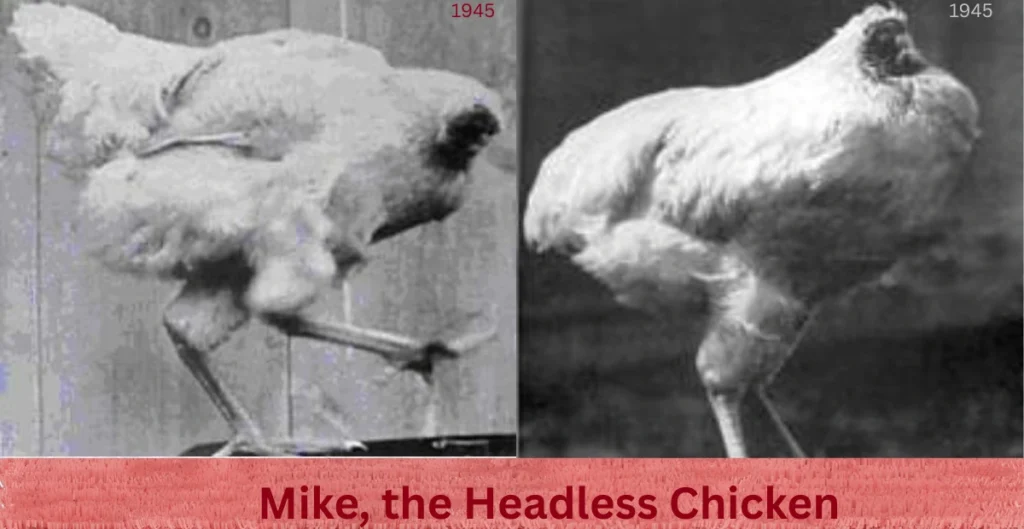
In 1945, a routine farm chore in Fruita, Colorado, turned into one of nature’s strangest marvels. When farmer Lloyd Olsen swung his hatchet to prepare a dish of Wyandotte rooster for dinner, he never imagined the bird—later named Mike the Headless Chicken—would stand up, walk, and live for 18 astonishing months without a head.
This is the unbelievable yet documented story of the chicken that defied biology, baffled scientists, and captured the hearts of people worldwide.
A Day That Changed Farm History
One day in September 1945, Lloyd Olsen selected Mike (a chicken) for supper. One clean stroke should have ended the bird’s life, but the hatchet missed the jugular vein and left part of the brainstem and one ear intact. Those small structures—controlled heartbeat, breathing, and reflexes—were enough for Mike to stay alive.
Instead of collapsing, Mike staggered upright, flapped, and even attempted to preen, beginning a journey no one could have predicted.
Mike the Headless Chicken
Lloyd was stunned at first. Mike staggered, fluttered his wings, and tried to walk, but he repeatedly fell. It seemed like he couldn’t live. The chicken should have died right away, but now it needed special care to stay alive. Lloyd and his wife, Frances, decided to care for the amazing bird.
It became challenging to feed Mike. Frances fed him liquid food with the help of a dropper because he couldn’t peck or swallow normally. Most of the time, his meals consisted of a milk-and-water blend mixed with tiny grains of corn.
Mike’s wound was open, so Lloyd had to be very careful about hygiene to avoid infections.
Mike adapted very well, despite being in a strange state. He could run, balance, and even try to crow, but his sounds were strange and guttural.
From Barnyard to Big Stage
It didn’t take long for ‘Mike the headless chicken’ to become a nationwide sensation. Reporters from local newspapers, scientists, and those interested in the topic came to see him. Within days of his beheading, Mike’s story started featuring in prominent American magazines.
Seeing an opportunity, Lloyd Olsen took Mike on a nationwide tour, where the remarkable bird delighted Americans at fairs, events, and exhibitions across the country. Mike earned money for the Olsen family, up to $4,500 a month, which was a substantial amount in the 1940s.
People were interested in both the show and the way it seemed to go against nature. Scientists were curious about how a chicken could live without a head.
Life on the Road
Mike resided in a custom-made pen while traveling with the Lloyd family. People applauded for him as he moved around and did strange things.
Anatomy of the Impossible
- Intact brainstem enabled Mike to survive, controlling critical activities such as breathing, heartbeat, and movement.
- Cerebellum control demonstrates that even without the forebrain, basic movements like walking and balancing can continue as long as people provide careful feeding and water.
- Reflexive movements allow chickens to perform instinctive actions, even if their brains are not fully operational.
The Final Chapter: Mike’s Death
Mike’s strange adventure came to a sad end in March 1947. While feeding Mike as usual, Lloyd accidentally let a kernel of corn lodge in the bird’s esophagus. Mike couldn’t clear his airway because he didn’t have his head to control his reflexes and ultimately gave in to one thing that even human care couldn’t stop.
For 18 months, Mike had a life that most animals and people couldn’t even imagine. He walked around his pen, ate with help, and became a symbol of strength and silliness.
People who lived nearby and tourists who came to see the chicken that defied nature were drawn to Mike’s tomb on the Lloyd Olsen farm.
Legacy That Refuses to Die
Mike’s narrative didn’t end with him; it continued. His memory spurred a celebration in Fruita, Colorado.
- “Mike the Headless Chicken Day” evolved into an annual festival that drew thousands of people to celebrate resilience, uniqueness, and the unexpected events that occur in life.
- Mike’s story sparked scientific conversations about how animals control their nerves, reflexes, and strategies for survival.
- Souvenirs, postcards, and even scientific articles told the strange story of his life.
Interesting Things and Side Stories
- Neuroscientists studied Mike and found out more about how chickens’ reflexes function. They said that most behaviors are controlled by the brain, but some instinctive and reflexive patterns can remain unchanged even if the brain is severely damaged.
- Some people who came were scared by what they saw of Mike. He seemed almost as if he were from another universe, walking around without a head, like a living exhibit that was hard to believe.
- A headless chicken became a cultural icon of both perseverance and absurdity.
- Mike inspired books, articles, and cartoons that demonstrate how to overcome all obstacles.
Key Takeaways: Understanding the Impossible
Mike was alive because people cared for him to stay alive. His story reminds us that scientists can be outwitted by nature through the resilience and adaptability of living things. It is beyond imagination that a headless chicken might even become a symbol of strength, humor, and the strange things that happen in life.
Though Mike the headless chicken died, his story lives on. It’s an amazing story of biology, human compassion, and a bird that has become immortal in mythology. Mike the Headless Chicken is proof that the natural world is strange, unlikely, and even miraculous for anyone who doesn’t believe it.